

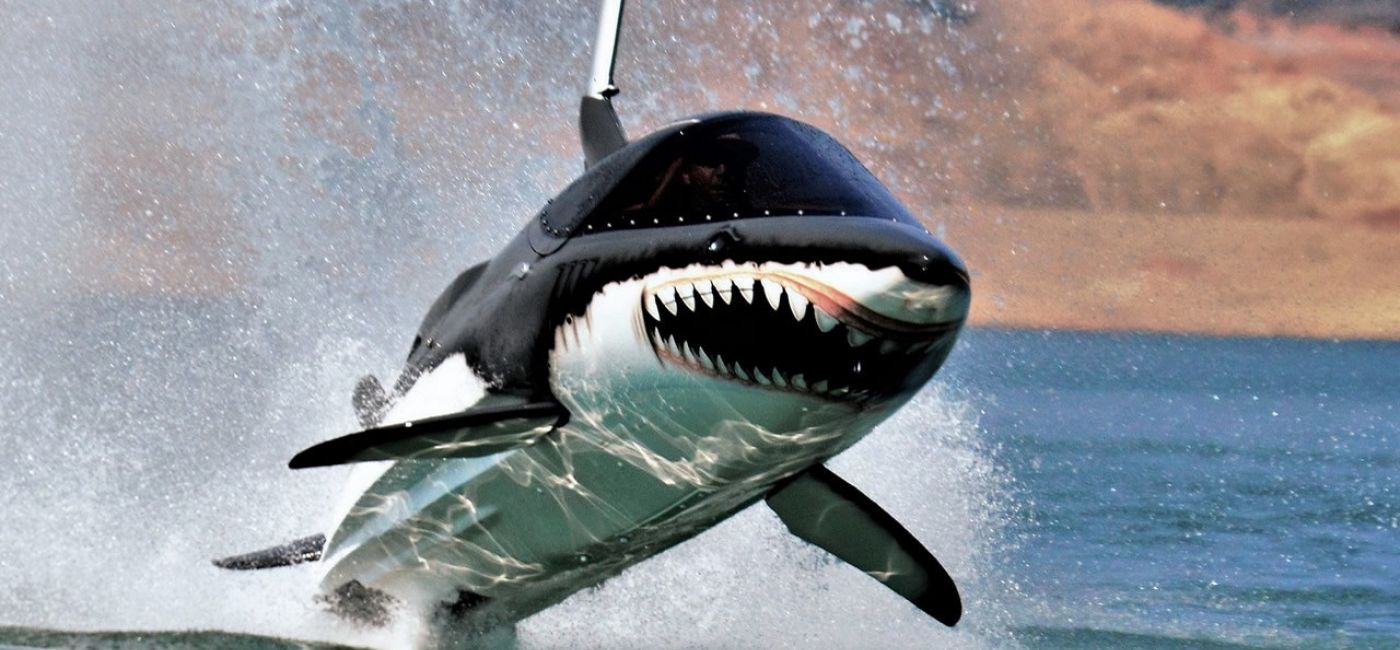
Amantes de la velocidad y la adrenalina, ya está aquí la primera moto acuática inspirada en la naturaleza, que además aprovecha los avances tecnológicos para ofrecer una experiencia sin precedentes en el agua, porque no sólo es velocidad, sino también saltos y pequeñas inmersiones.
Así es Seabreacher, un interesante desarrollo nacido en Nueva Zelanda que nos trae una mezcla de capacidades para ofrecernos lo que podría ser considerada la evolución de las motos acuáticas de alta velocidad.
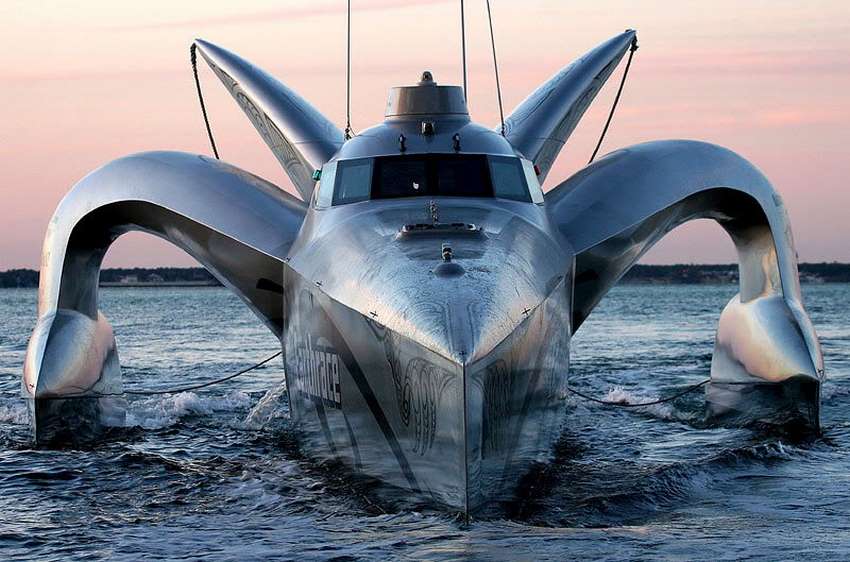
Earthrace, el barco futurista
El Top 1 de nuestra lista de barcos más raros del mundo lo encabeza el Earthrace, un barco futurista por su aspecto y también ecológico. Fue construido como ejemplo del uso de tecnologías amigables para el medio ambiente utilizando el biocombustible y el biodiesel para hacerlo funcionar, pero sin dejar atrás la velocidad. De hecho, en 2008 consiguió dar la vuelta al mundo en 60 días, 23 horas y 49 minutos, rompiendo así el récord de velocidad jamás conseguido con un barco.
Este trimarán futurista de 24 metros de eslora fue construido en 2005 con materiales de fibra de carbono y kevler. También incluye otras características como pintura no tóxica para el ecosistema. Su diseño aerodinámico, permite alcanzar los 40 nudos de velocidad y navegar sin repostar durante 3.700 kilómetros, mientras que su sistema hidráulico le permite penetrar las olas. Además, puede sumergirse hasta siete metros en caso de mal temporal en el mar. Sin embargo, 2010, fue embestido por un ballenero japonés y perdió la proa y desde entonces no ha vuelto a navegar.
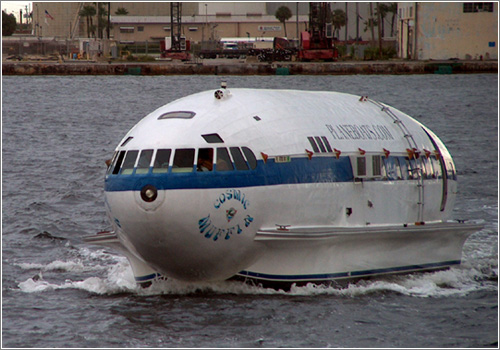
Cosmic Muffin,the aircraft ship
The Cosmic Muffin is the biggest recycling case on our list and has a curious history: it has served as a means of transport both by sea and by air. It was built in 1969 from a B-307 Stratoliner aircraft and took four years to become the exotic vessel it is today to sail the seas.
The owner who carried out this transformation is Kenneth W. London, a collector and pilot who wanted to fly around the world in it, but was prevented from doing so by World War II.Today, this plane boat belongs to David Drimmer and his company, Planeboats, had rented it out in the United States to people who wanted to sail aboard the most original boats in history.It is navigated from the main cockpit using the original flight controls.Its retro interior has very spacious rooms and all possible comforts.It is envisaged that the owner will use it for charitable causes such as fundraising or education projects.

Jet capsule, the capsule boat
This capsule boat combines the luxury of a yacht with exceptional manoeuvrability and comfort thanks, in large part, to the use of its materials: fibreglass and carbon fibre. Its rounded design manages to offer, in just 7.35 metres in length, so much interior space that it can be easily configured for various purposes: pleasure boat, sea taxi, patrol boat, water ambulance or discotheque, among others.
Known for its egg-shaped or spaceship design, this boat was manufactured by the Italian company Lazzarini Design in 2016. On board, it has a sheltered sundeck and a seating area for up to eight crew members. It has self-closing doors, a roof, a rear diving platform, a convertible bedroom and a toilet. Its configurations allow it to be converted from a limousine-style boat with two armchairs to port and starboard, to a taxi configuration with thirteen seats. At night, it is illuminated by the capsule's interior and exterior lights, designed to give the impression of a space vehicle floating on water.
WAM-V Proteus, the spider boat
The Proteus is a kind of catamaran with four huge, flexible, articulated legs that have crowned it the spider ship. These serve to connect the centrally located, open-air cockpit with the two floating hulls. According to its designer, Hugo Conti, this type of legs formed by sections of floats allow the boat to sail without breaking the waves, but rather adapting to them, and is therefore more efficient.
The spider ship was built with the aim of carrying out scientific and environmental research of the sea. With a length of 30 metres, it can sail 5,000 miles with a 9,000-litre diesel tank and has a capacity for 12 people. The main construction materials are titanium, aluminium and carbon fibre.
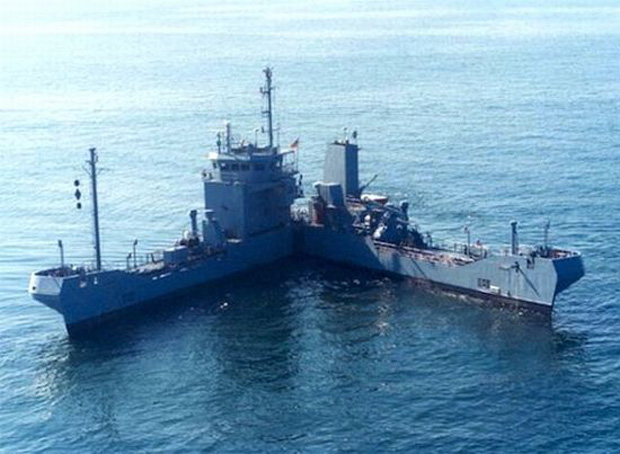
Bottsand Y 1643,the hinge boat
The Bottsand Y 1643 is a vessel that is designed to collect spills of oil spilled at sea. Popularly known as a hinged vessel because of the way it looks when it is in full operation with its two hulls open, it can clean up and remove up to 140 cubic metres of contaminated water.
The hinge ship was built in 1987, is 43 metres long and weighs 650 tonnes.When its two hulls are joined, it can reach a speed of ten knots and, when the ship is in the polluted area, it opens in half to 65º to collect the spills.Each of its hulls can be operated by only six technicians and its recovery tank can hold 790 cubic metres.
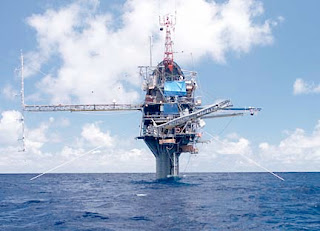
Flip, the vertical boat
Seeing the Flip boat in action is very impactful, as the first impression is that of a sinking boat, but don't worry, it's not sinking. Its main characteristic is that it remains in equilibrium in the middle of the ocean in a vertical position in order to carry out its functions, as the name with which we have christened it indicates.
It is a laboratory vessel of the United States Navy, built in 1962 and has a length of 108 metres.Its main tasks are the study of wave height, the collection of meteorological data and the measurement of parameters such as water temperature and density.It takes about 28 minutes to complete the whole process from horizontal to 90°. To enable it to pick up acoustic signals, it has not been equipped with any kind of engine and to move it from one place to another it must be towed. Its berths and toilets are built on universal joints, so that they can rotate together with the boat and can be used in any position. During the rotation, the passengers, which can be a maximum of 16, move from the bridge to the bulkhead.
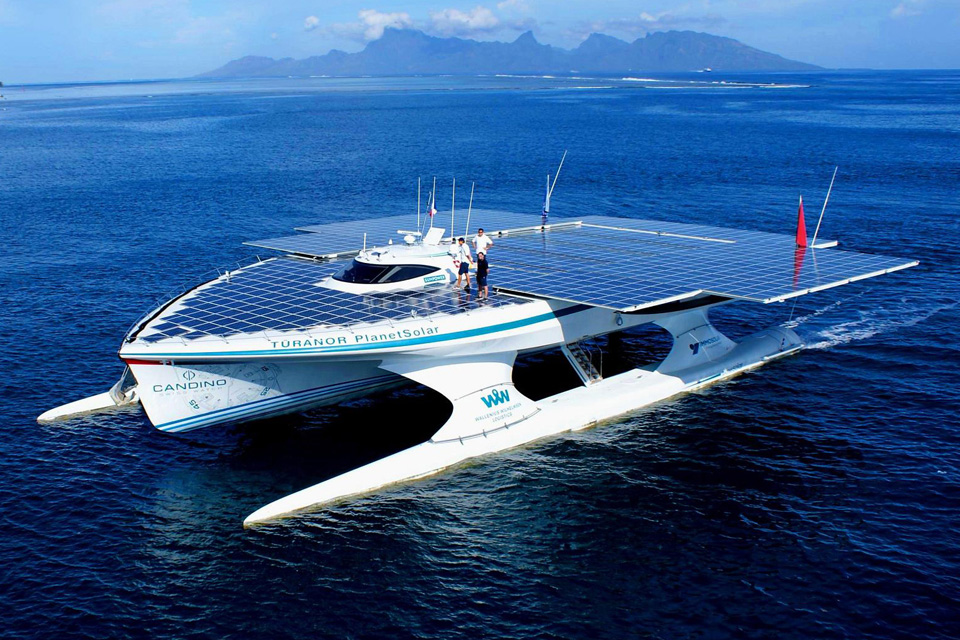
Turanor PlanetSolar, solar boat
The Turanor Planet Solar is a 31-metre catamaran that manages to sail only thanks to the solar energy collected by the solar panels located on its deck. It became the first solar-powered vehicle to travel around the world, a journey it completed in 584 days.
The solar boat spent some time moored in Barcelona in 2010 until it began its expedition around the world with a solar voyage objective: "to build fundamental knowledge and promote development in the area of solar mobility", according to the organisers. Specifically, it is covered with 516 square metres of solar panels and is driven at an average cruising speed of five knots, although it can reach a maximum of 14 knots. It also has "wings" that unfold to maximise its energy-harvesting potential.
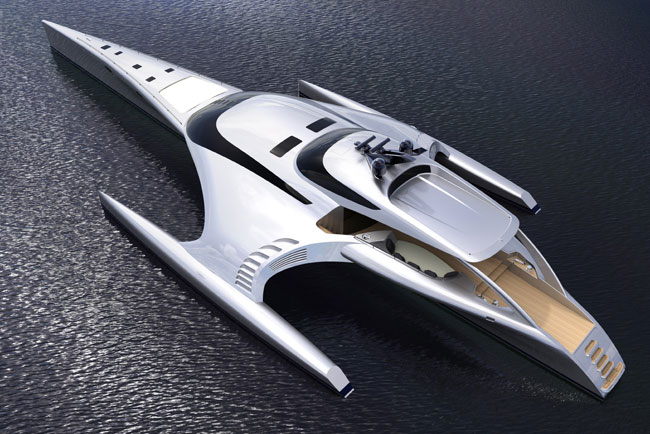
Adastra, the space rocket boat
The Adastra is a super trimaran yacht valued at over 11 million euros. It was built in 5 years by McConaghy Boats with the purpose of being able to sail half way around the world with a single tank without forgetting the luxury and comfort of the passengers at all times.In other words, it offers the speeds of a racing trimaran, but in a yacht that is sufficiently stable and sumptuous, as well as efficient.
Although it can reach high speeds on the open sea (its maximum is 22 knots), the yacht's nickname comes more from its shape, as the two smaller side hulls, together with the much more elongated main hull located in the centre, are reminiscent of a rocket. Its superstructure is built in carbon fibre and the hull in fibreglass and Kevlar. Equipped with an 850 kW Caterpillar engine in the central hull and two 80 kW Yanmar engines in the side hulls, the rocket boat consumes 90 litres per hour at a speed of 13 knots. When it slows down to 10.5 knots, it can cover 18,500 kilometres without refuelling, under full load conditions, with a consumption of 25 litres per hour.


Our Brands


Náutica Santa Eulalia is a Spanish company founded in 1990 that offers charter services, mooring rental, exhibition and sale of boats, sale of spare parts, workshop and storage.
Company
Contact
-
This email address is being protected from spambots. You need JavaScript enabled to view it.